


Next: Black Holes Up: Orbits of Photons Previous: Orbits of Photons Contents
With no mass
 , the equation reduces to
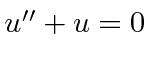 which has the solution
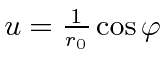 which is the equation of a straight line written in polar coordinates.
Lets
solve the full equation to first order in the small parameter
which is the equation of a straight line written in polar coordinates.
Lets
solve the full equation to first order in the small parameter
 .
The full solution will be the solution for with
.
The full solution will be the solution for with
 plus a small perturbation due to the mass.
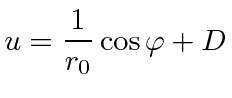 |
 is perturbation to line is perturbation to line |
||
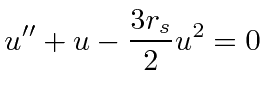 |
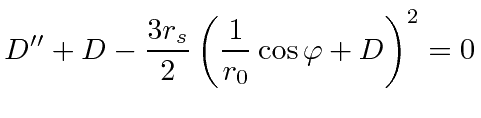
the differential equation | ||
 |
plug in aprox.  |
||
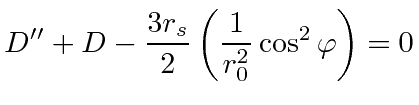 |
drop terms higher order in  |
||
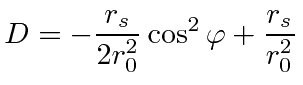 |
guess solution, plug in hw |
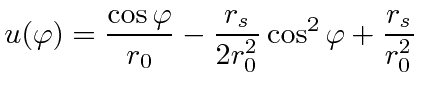 |
We can rather simply
compute the deflection of light from this.
At large
 ,
,
 and for small
we
expect
and for small
we
expect
 to be near to
 there.
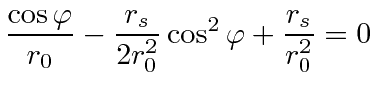 |
|
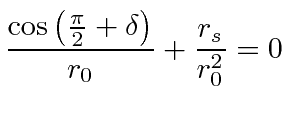 |
|
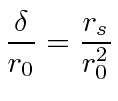 |
|
 |
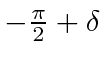 so the total angular deflection of light is
 .
.
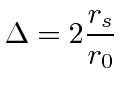 |
Jim Branson 2012-10-21